https://www.instagram.com/reels/DGTxZ2FTLUn
But it is a sacred space, so that’s not nothing, or course. There is a bit a semantics, as always in Western thinking, to wade through, before we get to the “meat” (because we don’t eat meat) of what is going on with The Mat.
My mat journey started when I was very young, in the 1960’s, when yoga in the United States was actually relatively “pure” – representative of the source teachings of the Patañjali Yogasūtra This is not the main point of this post, so I won’t be arguing “purity” at length. The important thing is that nobody had or even could have had a performance yoga mat by Manduka – or any other company. The mats were hand woven, imported from India (via mail!), or, perhaps we got them from Mexico – again, hand-woven, universally, hand-dyed, but above all, made of natural materials, e.g. wool. Not even a rubber mat.
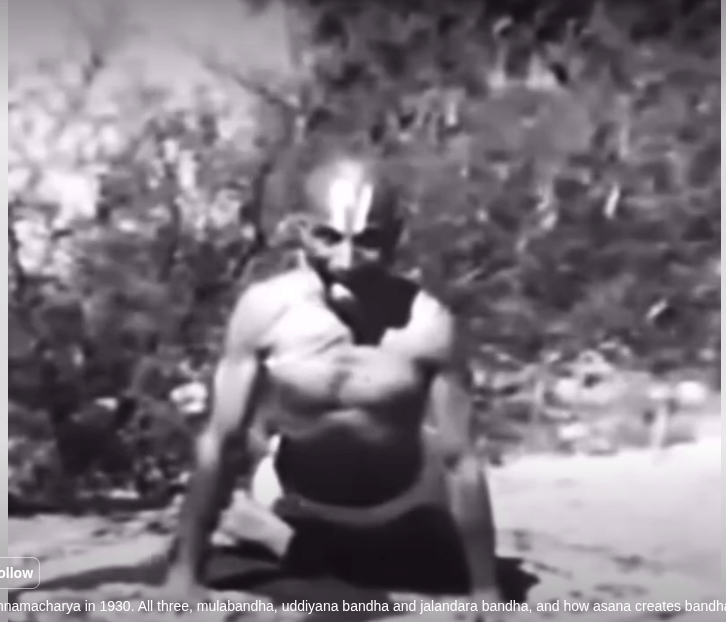
If you watch the famous, but rare, videos of B.K.S. Iyengar as a child/young man, doing possibly the most beautiful yogaasanas ever recorded, he is on a “rug”, or, on the dirt. or, on a rug, on the dirt. Now, that was possibly not significant in terms of the practice: it was the socioclutural reality of that time and place. None of the yoga texts from Patanjali’s time specify anything about “equipment”. Much later, the Haṭha Yoga Pradīpikā (,, written by Svātmārāma, Chapter 1, Verses 12 and 13, tells us:
The Haṭha yogi should dwell alone in a small hut, situated in a well-governed and righteous country, where food is easily available and there are no disturbances. The space surrounding the hut, up to the distance of a bow’s length, should be free from stones, fire, and water.
The characteristics of the Yoga hut, as described by the Siddhas who practice Haṭha, are as follows: it should have a small door, be without any holes or cracks, be neither too high, too low, nor too long, be well-plastered with a thick layer of cow dung, be clean and void of all insects. Outside, it should be made attractive with a porch (mandapa) and a raised platform (vedika), and be surrounded by a wall.
No mats mentioned. Of course, it does indeed refer to a sacred space – presumably the yogi would do their practice within this space, only leaving the hut to beg for food. I guess that in modern mobile times, the mat has become the portable sacred space?
I used a cloth mat for maybe 30 years, without really thinking about it. At some point, I came “out of the closet”, and went to a modern yoga class, with my smelly old cloth mat. At that point, I was not really forcing myself to “jump through” or “jump back”, between poses, and when I tried, I was not successful. Of course, I really just needed to remember that the practice will provide all that is required: the equipment can’t make it happen. However – and this is the point – the equipment can teach you, if you are open to being taught. Actually, anything can teach you, if you are open, within the framework of Yogasūtra.
What the cloth mat did for me was stop me from jumping through (jumping back was not such a problem): my feet would catch on the mat – or so I thought was the issue. But, obviously – for those who know – the mat was never the problem. There is a way to jump through, and you must discover it (“discover” = “learn”).
But in my Western Weakness, I decided that it was that Manduka Pro that would make it happen for me; so, I bought one. Even then, my feet did not always clear this incredible invention! For many years, I developed this “workaround” where I would smear my own sweat on the mat, at the point where my feet need to clear for the jump back, providing just enough lubrication.
That too was “error” – one of the 5 vrttis*: it was never the mat that made it happen/not happen, even though it really “seemed” like that was the case. The mat can neither promote nor prevent the asana – it can only guide or instruct. (At some point, I will write a long post about the teachings of cloth that cloth teaches us a lot about physiology and physics – yet another “power” of the mat.
One day, it “occurred to me” – I was able to transcend my stubborn ignorance**, i.e. ignorance born of stubbornness, that the mat was really no longer a hindrance to my jump back. I just knew it.
I found a mat that really spoke to me (again, the mat doesn’t really do anything – but something, like speaking to me, does get done). Not a plug, but check out Öko Living Mats. I have come to “worship” my mat now, which lives is my “yoga hut”. When I think of the mat, it recalls to my mind the joy of my practice. And I can easily jump through and jump back. In fact, all the things that young yogis complain about, concerning mat technology, are not problems I face with my wool mat – and I guarantee that they are not real problems for anyone, with the right vision and patience.
The final note concerns the modern yoga mats: it is unconsciounalbe for a yogi to support a “product” made entirely from syntetic material, that pollutes the planet, and your own body. Period. In the West, we are drunk on the corporate “explanation” of why our true thinking is really false. Again, Viparyaya.
As an example, but not to pick on them, Manduka Pro is made of PVC (polyvinyl chloride) and a polyester fabric mesh. They do/did offer a “rubber” mat, which I used exclusively for a long time, thinking it was better. The rubber mat would deteriorate after a couple of years – again, the mat did nothing! Actually, at a certain point, the quality of the rubber mats took a dive, and would not even last me 6 months.
For the Manduka Pro, the primary material is PVC, which is chemically synthesized starting from natural gas (or crude oil) and salt (brine). While the creation of PVC traditionally involves highly toxic chemicals (like VCM and chlorine gas), Manduka states that their finished PRO mats are 100% latex-free and free of toxic phthalates. The PRO series holds the STANDARD 100 by OEKO-TEX® certification (a strict European environmental standard). This certification verifies that the final textile product has been tested and is free from harmful levels of over 100 problematic chemicals and substances.
A key aspect of the Manduka PRO’s production is that the facility uses an “emissions-free” manufacturing process, meaning the toxic emissions typically associated with PVC production are contained and not released into the atmosphere.
Fiinally, Manduka does not disclose the specific name of the factory or the individual workers who produce the mats. However, because the manufacturing takes place in Germany, the labor is performed by factory workers operating under European Union and German labor laws. These laws include strict regulations on occupational safety, working hours, fair wages, and heavy workplace restrictions on exposure to hazardous chemicals (such as VCM limits) compared to facilities in countries with looser industrial regulations.
So, kudos to Manduka for all this work to maintain the Viparyaya that a major corporate manufacturer, producing something from PVC, is actually non anathema to the eight limbs of yoga. Undoubtedly, there are many yoga mat manufacturers who don’t lift a finger for the environment or workers’ rights.
In contrast to the industrial, chemical-based manufacturing of standard PVC mats, Öko Living produces “yoga rugs” using traditional Indian textile methods that prioritize biological health and ethical labor. Öko Living mats are hand-loomed rather than machine-pressed. The process follows the ancient practice of Ayurvastra (a branch of Ayurveda meaning “health garment”). In short, While a Manduka PRO is a high-tech German industrial product designed for lifetime durability and “closed-cell” hygiene, an Öko Living mat is a traditional “living” textile designed for skin health, environmental regeneration, and the preservation of artisan heritage.
This might have wandered into some kind of comparison between two yoga mat companies. This was not the goal, which was to describe the mat as a sacred space, with no particular magic. I also wanted to show how the mat could be a teacher of truth. Finally, while the mat does no “do” anything, as with everything in the universe, it does produce karrma, which will produce other karma, which mat be beneficial, or not beneficial. For this reason, we need to find the mat that is more likely to produce the beneficial karma.
—- footnotes—
* Yoga Sūtra 1.8: viparyayo mithyājñānam atadrūpapratiṣṭham
Translation: “Error (Viparyaya) is false knowledge (mithyājñānam) established on a form that is not its own (atadrūpapratiṣṭham).”
** Viparyaya is considered a major obstacle because it is the root of Avidyā (ignorance), which is the first of the five kleśas (afflictions).


Leave a comment